




Your CDN bill can stay tolerable for months, then a launch, live event, or new APAC audience makes the delivery model impossible to ignore. At that point, searching for a Cloudflare alternative is easy; finding one that replaces the part of Cloudflare you actually use is harder.
This guide is deliberately narrow. It compares CDN and media-delivery options for platform, DevOps, and video teams. It does not pretend that a delivery CDN is also a replacement for Cloudflare DNS, Tunnel, Workers, Pages, WARP, Zero Trust, a web application firewall, or bot management.
What is the best Cloudflare alternative for CDN and media delivery?
The best Cloudflare alternative depends on the workload: ZeroBuffer fits video teams that want one streaming platform with included encoding and one rate, CloudFront fits AWS-native stacks, Fastly fits programmable delivery, and Akamai fits complex enterprise streaming. If you need Cloudflare's security, DNS, or compute portfolio as well as CDN delivery, no CDN-only replacement is equivalent; split the services or keep Cloudflare for those layers.
That distinction matters because Cloudflare itself has two relevant media paths. Its general cache can distribute media from more than 300 edge locations, while Cloudflare Stream stores, encodes, and delivers live or on-demand video through a separate usage model (Cloudflare media caching, Cloudflare Stream pricing). A fair comparison starts by deciding which path you are replacing.
Before choosing a Cloudflare alternative, define the boundary
"Replace Cloudflare" can describe four very different projects:
- Replace only CDN delivery. Keep authoritative DNS, application security, and compute where they are. Move static assets, downloads, HLS or DASH segments, and perhaps images to a new delivery hostname.
- Replace a managed video platform. Move storage, encoding, manifests, playback, delivery, and analytics away from Cloudflare Stream.
- Replace the security edge. Rebuild WAF rules, DDoS controls, bot policies, TLS, rate limits, logging, and origin access. The CDN shortlist in this article is not sufficient by itself.
- Replace the developer platform. Migrate Workers, Pages, KV, R2, Durable Objects, Tunnel, or Access. That is an application-platform program, not a CDN procurement exercise.
Write the boundary in one sentence before requesting trials. For example: "Move media.example.com HLS and image delivery, preserve our current DNS provider, and keep application authentication unchanged." That sentence prevents a low egress quote from winning a project it cannot complete.
Cloudflare's default cache behavior also exposes practical requirements worth carrying into the evaluation. It respects origin cache directives, supports byte-range responses when the origin sends Content-Length, collapses simultaneous cache misses within a data center, and imposes plan-dependent cacheable file-size limits (Cloudflare cache behavior). Your alternative needs equivalent behavior where the workload depends on it—not merely a long list of points of presence.
The seven inputs that make comparisons useful
Build one workload sheet with:
- Monthly viewer delivery by region, not just the global total.
- Peak requests per second and the event ramp profile.
- Object mix: HTML, images, large downloads, HLS or DASH manifests, and media segments.
- Cache-hit ratio by object type and the origin traffic created by misses.
- Required controls such as signed URLs, token authentication, geo-restrictions, and purge semantics.
- Upstream services: object storage, encoder, packager, player, logs, and quality-of-experience analytics.
- Contract needs: support response, uptime commitment, traffic minimum, and exit terms.
The result turns a vague search for an alternative to Cloudflare into a testable infrastructure decision.
Cloudflare alternative comparison at a glance
| Provider | Best fit | Public billing signal | Media workflow | Important boundary |
|---|---|---|---|---|
| ZeroBuffer | Video teams that want one streaming platform and one rate | Flat $0.0049/GB worldwide; lower volume tiers | Video streaming, S3-compatible storage, and included multi-rendition encoding | Not a replacement for Cloudflare DNS, WAF, Tunnel, Workers, or Zero Trust |
| Amazon CloudFront | AWS-native applications and media pipelines | Flat-rate plans capped per distribution, or regional usage pricing | CDN integrated with S3 and AWS media services | Complete workflows can span several AWS services and billing dimensions |
| Fastly | Engineering teams that need programmable cache behavior and rapid purging | Usage pricing by bandwidth region and requests | Delivers packaged HLS, DASH, and other HTTP media | Higher public per-GB rates; media delivery must be enabled for the account |
| Akamai | Large broadcasters, rights holders, and governed enterprise deployments | Quote-based buying motion | Adaptive Media Delivery for prepared live and VOD streams | Enterprise procurement and configuration are heavier than self-service CDNs |
The table is a shortlist, not a benchmark. Network size claims use different definitions, and public rates do not predict cache performance, playback quality, or the negotiated price you may receive. Test the same URLs, regions, and failure cases on every candidate.
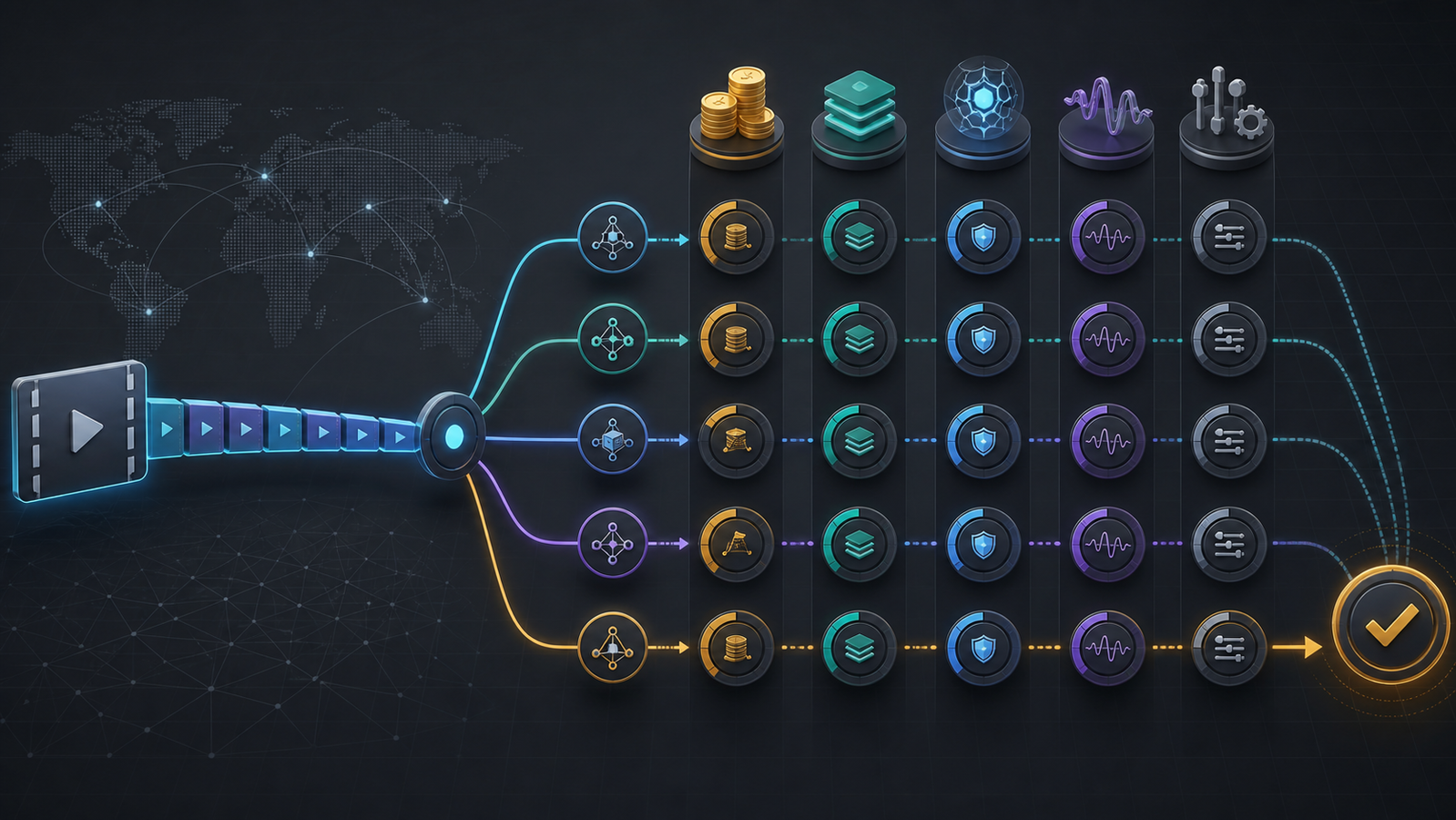
Four Cloudflare alternatives for CDN and media workloads
1. ZeroBuffer: best for video teams that want one platform
ZeroBuffer is the strongest fit when the problem is worldwide video delivery rather than a missing security suite: video delivery is $0.0049/GB in every region, with S3-compatible storage and multi-rendition encoding in the same workflow (ZeroBuffer pricing). HLS streaming over HTTPS and HTTP/3, instant purge, and a 99.99% uptime SLA give a video team the delivery controls it needs without regional bandwidth tables (how ZeroBuffer works). The honest limit is equally important: it does not replace Cloudflare's DNS hosting, WAF, DDoS product, Tunnel, Workers, WARP, or Zero Trust portfolio.
At 100 TB of viewer delivery, the listed delivery line is straightforward: multiply bytes delivered by one worldwide rate. The evaluation still needs to measure cache hit ratio, startup time, rebuffering, purge behavior, and performance in the markets that matter to your audience.
This option deserves priority when:
- Media traffic reaches several continents and regional surcharges make budgets hard to forecast.
- Encoding is currently a separate bill or operational pipeline.
- The team wants storage, delivery, player telemetry, and video analytics to share one operating surface.
- A free-to-start, no-card trial is preferable to a contract-first proof of concept.
For a deeper workload model, use the existing CDN for video cost guide before testing vendors.
2. Amazon CloudFront: best for an AWS-native stack
CloudFront is the natural candidate when S3, MediaConvert, MediaLive, MediaPackage, IAM, CloudWatch, and the rest of the application already live in AWS. AWS does not charge data transfer from an AWS origin such as S3 or EC2 into CloudFront, while viewer delivery, requests, and optional features follow the selected pricing model (CloudFront overview).
Buyers now need to compare two CloudFront commercial paths. Standard distributions retain pay-as-you-go dimensions that vary by usage and geography. AWS also documents flat-rate plans that can bundle CloudFront with WAF, DDoS protection, Route 53, logging, edge compute, and S3 credits, with plan-specific allowances (CloudFront flat-rate plans).
That bundle looks attractive against the "Cloudflare alternative free" intent, but the sticker price carries scope with it. Each plan covers one distribution, so a platform with separate video, image, and download distributions buys several. The allowance is the design point rather than a bandwidth grant: AWS can respond to substantial sustained excess by serving from fewer or more distant edge locations, which turns a media traffic spike into a playback problem rather than an invoice. Check eligibility, excess-usage handling, the number of domains or distributions required, and which application services remain outside the plan. The Amazon CDN cost guide works the numbers through.
Choose CloudFront when AWS integration removes more engineering work than the service composition adds. If the stack is cloud-agnostic or finance needs one delivery rate across every region, its operational and billing surface may be more than the workload needs.
3. Fastly: best for programmable delivery control
Fastly fits teams that treat CDN configuration as application infrastructure. It supports static and dynamic content, Instant Purge, and packaged HTTP streaming formats including HLS and MPEG-DASH. Fastly notes that video must already be packaged and that customers should request video delivery on their account (Fastly content delivery documentation).
The public pricing page currently includes 100 GB of Full Site Delivery bandwidth and one million requests in its free tier. Beyond that, bandwidth is billed per GB by region—for example, the first paid tier is $0.12/GB in Europe and North America and higher in several other regions—while requests are a separate dimension (Fastly pricing).
That is not the lowest public media rate in this shortlist. The reason to select Fastly is control: cache semantics, rapid invalidation, edge logic, and observability that an engineering-heavy organization can shape around its application. Price that engineering capability against the workload; do not rank it on egress alone.
Choose Fastly when custom behavior and deployment control are requirements. If the actual job is standardized HLS or DASH delivery at predictable worldwide cost, a media-focused platform can remove work rather than add knobs.
4. Akamai: best for complex enterprise streaming
Akamai belongs on the shortlist for major live events, large rights holders, strict governance, and established enterprise media operations. Adaptive Media Delivery is designed for prepared, pre-segmented live and on-demand streams and supports HLS, MPEG-DASH, and CMAF among other formats (Akamai supported formats).
Its documentation exposes media-specific controls that generic comparison pages often miss. Teams can describe catalog size, object size, resolution, segment duration, and delivery mode; live and on-demand modes receive different TTL treatment, and optional capabilities cover access revocation, cloud-origin authentication, reporting, and low-latency workflows (Akamai content characteristics).
Public list pricing is not the center of this buying motion. Expect scoping, an account team, a contract, and a proof of concept that reflects the real event profile. Ask which products and support tiers are required for origin shielding, token security, low latency, event support, log delivery, and service commitments.
Choose Akamai when governance, protected premium media, operational support, and extreme event readiness justify that process. A smaller team serving ordinary segmented media should still test whether a simpler flat-rate path can meet the same measured objective.
How to choose the right Cloudflare alternative by workload
For global HLS or DASH delivery
Start with ZeroBuffer, then add Fastly if custom edge behavior is material and CloudFront if the origin already sits in AWS. Compare identical manifests and segments across each provider. Measure video startup time, rebuffer ratio, error rate, cache-hit ratio, origin requests, and cost per delivered viewing hour.
Do not use average ping as the verdict. A video path includes DNS, connection setup, manifest retrieval, segment availability, cache state, player buffering, and origin behavior. The adaptive bitrate streaming guide explains why player outcomes matter more than one network latency number.
For a managed live or on-demand video API
Compare the whole pipeline, not CDN egress in isolation. Cloudflare Stream bills $5 per 1,000 stored minutes and $1 per 1,000 delivered minutes, with encoding and bandwidth included. ZeroBuffer combines per-GB delivery with included multi-rendition encoding and its documented storage rate.
Normalize minute-based services into bytes using your bitrate ladder and viewing mix, then add storage, encoding, packaging, player, DRM, analytics, requests, and support. A service can be cheaper for short low-bitrate clips and more expensive for long high-bitrate viewing—or the reverse—without either price page being misleading.
For AWS-hosted applications
Put CloudFront in the first test group. Origin transfer from AWS services into CloudFront, IAM integration, private S3 origins, and existing monitoring may reduce migration work. Compare that convenience with the complete bill and the number of services the team must operate.
For custom edge logic
Put Fastly and CloudFront into the technical evaluation. If the current application depends on Workers APIs, first inventory every binding, route, KV namespace, queue, and stateful behavior. CDN rules or lightweight functions may cover headers and redirects, but they are not automatic substitutes for an application built around Workers.
For a Cloudflare DNS alternative, Tunnel alternative, or WARP alternative
Run a separate search and a separate migration. DNS authority, private network access, device clients, identity, and secure web gateway policies have different failure modes from media delivery. Keeping Cloudflare for those layers while moving a high-bandwidth hostname to another CDN is often safer than forcing one vendor to replace everything.
This split-vendor design is normal. Use distinct hostnames, document the ownership boundary, restrict the origin to the chosen delivery path where possible, and keep independent monitoring. For resilience beyond a simple separation, see the multi-CDN strategy guide.
A migration plan that protects playback and rollback
1. Inventory behavior before copying configuration
Export hostnames, certificates, cache rules, cache keys, TTLs, redirects, signed URL logic, origin headers, range-request behavior, purge calls, logs, and alert thresholds. Record what each rule accomplishes. Copying syntax without intent recreates obsolete behavior and misses implicit defaults.
2. Establish a provider-independent baseline
Capture at least seven days that include normal peaks. For web delivery, record cache status, time to first byte, response size, origin traffic, error rate, and Core Web Vitals where relevant. For video, add startup time, rebuffer ratio, fatal playback errors, bitrate switches, and regional viewing hours.
3. Reproduce a small, representative path
Create a trial delivery hostname and use a controlled subset of objects or traffic. Test cold cache, warm cache, byte ranges, conditional requests, expired objects, signed URLs, purge, origin failure, large files, and traffic bursts. HLS tests need both manifests and segments; a green homepage check proves little about playback.
4. Separate DNS cutover from application change
Keep the viewer-facing hostname stable where possible and point it to the new provider through a staged DNS change. Lower TTL ahead of the window, but remember that resolver and client caching can outlive expectations. Do not combine an encoder change, player release, storage migration, and CDN cutover unless the risk is unavoidable.
5. Warm what matters and protect the origin
Prioritize popular VOD assets, current live manifests, startup segments, application bundles, and hero images. Validate request collapsing or shielding before a major event. A cold fallback CDN can turn an edge incident into an origin overload.
6. Ramp by audience or traffic percentage
Move internal users, one region, or a small traffic share first. Compare the same service-level indicators against the old path and set explicit stop conditions. A rollback should be a rehearsed routing change, not a late-night configuration rebuild.
7. Keep dual delivery until the evidence is boring
Maintain the previous path long enough to cover cache churn, token expiry, traffic peaks, and at least one representative release or event. Reconcile billing data as well as performance. The migration is complete when operations, finance, and product all see the expected result.
Frequently asked questions
Is there a free Cloudflare alternative?
Yes, but "free" has boundaries. Fastly lists free delivery and request allowances, and CloudFront offers a free flat-rate tier as well as ongoing free usage allowances for standard pricing; verify current eligibility and included dimensions before treating either as a production budget. For high-bandwidth video, the more useful comparison is usually total cost at the real bitrate and regional mix, where ZeroBuffer's free-to-start trial and flat delivery rate keep the evaluation tied to production economics.
What is the cheapest alternative to Cloudflare for CDN delivery?
Compare the complete bill, not one headline rate. ZeroBuffer lists $0.0049/GB worldwide with no regional surcharge, contract, or minimum, so a global audience prices the same way an audience in one country does. Providers that publish a lower entry rate usually attach it to a smaller network, a single region, or a capped plan, so add cache-fill costs, requests, storage, encoding, regional mix, support, and minimums before ranking them.
Can I switch CDN providers without changing authoritative DNS?
Usually, yes. You can keep your DNS provider and change the CNAME or equivalent record for a delivery hostname to the new CDN. Plan certificate validation, origin access, TTLs, cached DNS answers, and rollback before changing production traffic.
Is Cloudflare Stream a good fit for a video platform?
Cloudflare Stream suits applications that want minute-based managed video behind one API and do not mind billing that moves with stored and delivered minutes rather than bytes. It is a weaker fit once the bitrate ladder, catalog size, or viewing hours make per-minute pricing unpredictable. ZeroBuffer covers the same workflow on flat worldwide per-GB delivery with included multi-rendition encoding, without claiming to replace Cloudflare's unrelated security or compute services.
Is CloudFront an alternative to Cloudflare?
CloudFront is a strong alternative for CDN delivery, especially when origins and operational tooling already use AWS. It is not a drop-in replacement for every Cloudflare product; WAF, DNS, edge functions, access controls, logs, and media processing may involve separate AWS services or plan features.
What should replace Cloudflare Workers or Tunnel?
Treat each as a separate platform decision. Workers alternatives must match runtime APIs, state, data bindings, and deployment behavior; Tunnel alternatives must match private connectivity, identity, routing, and device requirements. A media CDN should not be selected as the answer to either problem.
Choose the smallest replacement that solves the expensive problem
A Cloudflare migration does not have to replace the whole orange cloud. If high-bandwidth delivery is the expensive or inflexible layer, isolate that hostname and compare ZeroBuffer, CloudFront, Fastly, and Akamai with one workload, one scorecard, and one rollback plan.
Keep Cloudflare where its security, DNS, or compute products still earn their place. If predictable global media egress, included encoding, and a focused video workflow are the goal, start a ZeroBuffer trial with a representative asset set, then make the decision from playback data and the modeled production bill.