
One CDN can look perfectly reliable—until a regional route degrades during a launch, a live event overwhelms capacity, or an outage takes your only delivery path with it. A multi CDN strategy can reduce that concentration risk, but it also adds a steering system, duplicated configuration, fragmented caches, and another operational surface your team must own.
The useful question is not “Are two CDNs better than one?” It is “Will a second CDN improve our user-facing reliability enough to justify the cost and complexity?” This guide gives platform, DevOps, and streaming teams a concrete way to answer that question and build the smallest architecture that meets their service goals.
This is not a CDN vs caching choice: each provider still needs sound cache policy. Multi-CDN adds a decision layer above those independent caches.
What is a multi CDN strategy?
A multi CDN strategy delivers the same content through two or more independent content delivery networks and uses a steering policy to choose which network serves each user. Teams adopt it to improve availability, regional performance, burst capacity, or commercial leverage—but those benefits only appear when failover, configuration parity, and monitoring are actively maintained.
This differs from a CDN that uses many points of presence inside one provider. A single provider may have a broad global network, but its control plane, configuration model, and organizational failure domain are still concentrated with that vendor. Multi-CDN introduces a separate delivery path.
It also differs from origin load balancing. Origin failover protects the source of the content; CDN failover protects the edge path between users and that source. A resilient service may need both, because two CDNs that depend on one fragile origin have merely moved the single point of failure upstream.
When a multi CDN strategy is worth it
Multi-CDN is a means, not a reliability badge. Start with a measurable requirement and compare it with the cost of improving the current provider.
It is usually worth serious evaluation when one or more of these conditions apply:
- A delivery outage creates material revenue, contractual, safety, or reputational loss.
- Performance varies meaningfully by country, ISP, or access network, and no single provider wins across the audience footprint.
- A live event, game release, software launch, or sale can exceed one provider’s proven capacity.
- Your service-level objective cannot tolerate the failure domain of a single CDN vendor.
- You need pricing leverage or cost-aware routing at a volume where provider commitments materially affect spend.
- Residency, licensing, or contractual rules require different delivery paths in particular markets.
The AWS guidance for multi-CDN video delivery identifies aggregate capacity, geographic reach, resilience, and performance as the common drivers. That framing is important: “we might be safer” is not a design input, while “maintain playback success above our target in our top ten markets during a provider incident” is.
Stay with one CDN for now when
A second provider is often premature if traffic is modest, the current CDN already meets regional performance and availability targets, or nobody owns 24/7 delivery operations. The same is true when your application relies heavily on proprietary edge functions, image transformations, bot controls, or token schemes that cannot be reproduced elsewhere.
Before adding a provider, check whether origin shielding, cache-policy cleanup, better alerting, additional capacity, or a stronger support plan would solve the actual problem. The CDN Handbook’s fit analysis makes the tradeoff explicit: multi-CDN can improve resilience, but it is a poor fit for low traffic, small operating teams, and workloads bound to vendor-specific features.
Use a simple test: if you cannot state the failure or performance condition that triggers a switch, how quickly the switch must help, and which user metric proves recovery, you are not ready to add steering.
How a multi CDN strategy works
Every design has four functional layers:
- A shared content source. Each CDN must retrieve equivalent objects from the same origin, replicated origins, or synchronized storage.
- Provider configurations. Hostnames, TLS, cache keys, TTLs, authentication, WAF rules, compression, and purge behavior must be compatible.
- A decision engine. Steering logic selects a CDN using health, geography, performance, capacity, cost, or a combination of signals.
- Independent measurement. Synthetic checks and real-user or player telemetry show whether the selected CDN is actually helping users.
The decision engine is the defining layer. Buying two contracts without a tested way to shift traffic creates inventory, not resilience.
DNS-based steering
An authoritative DNS service returns a provider-specific CNAME or address according to health, geography, weights, or performance data. This pattern works for web assets, downloads, APIs, and video, requires little client logic, and can support active-active or active-passive operation.
Its main constraint is caching. DNS responses remain in recursive resolvers and devices until their time to live expires, so a policy change does not move every user immediately. TTL semantics are part of the base DNS specification in RFC 1035, and real resolvers do not produce a perfectly synchronized cutover.
DNS steering is a strong default when failover in tens of seconds or minutes meets the recovery objective. It is weaker when an in-progress stream must change path quickly.
HTTP redirection or a layer 7 aggregator
An HTTP service can redirect a request to a provider-specific hostname, while an aggregator or reverse proxy can select a provider for each request. These approaches allow finer-grained and faster decisions than DNS, but the steering tier sits directly in the request path.
That creates a new design obligation: the steering service must be more resilient than the delivery paths it controls. It must also avoid becoming a throughput bottleneck or adding enough latency to cancel the performance benefit.
Client-side and player-level steering
An application or video player can select from multiple base URLs, retry on another provider, or periodically fetch steering instructions. This makes per-session and even midstream changes possible because the client can respond without waiting for DNS caches.
For streaming, standards now provide a cleaner route than proprietary player logic. Apple’s HLS Content Steering specification defines an external steering manifest that lets clients prioritize pathways and reload instructions. DASH-IF describes the same core capability for MPEG-DASH: a distributor can direct a player to another content source at startup or midstream through a remote steering service in its Content Steering guidance.
Client steering is powerful, but support must be verified across the actual player matrix. Older clients that ignore steering signals still need a safe default pathway.
Choose active-passive or active-active operation
The operating mode determines how warm the backup is and how much complexity you accept during normal traffic.
| Mode | Normal routing | Best fit | Main risk |
|---|---|---|---|
| Active-passive | Primary serves nearly all traffic; backup receives probes or a small warm-up share | Teams prioritizing outage recovery with simpler cost control | Cold caches and untested capacity when traffic moves |
| Active-active | Two or more providers continuously serve meaningful traffic | Regional optimization, continuous validation, large events | More policy tuning, cache fragmentation, and commit management |
| Regional primary | One provider is preferred per geography, with another as backup | Audiences where provider performance varies by market | Regional rules can become stale as networks change |
| Content-aware split | Traffic differs by asset type, such as manifests, segments, images, or downloads | Workloads with distinct latency and cost needs | Feature and cache behavior can drift by content class |
Active-passive is easier to explain, but a backup receiving zero production traffic is difficult to trust. Send a small, representative share to it, verify cache behavior, and prove it can authenticate users and reach the origin before an incident.
Active-active keeps both paths exercised and can route around regional weakness. It also means both providers affect users every day. Use stable weights, minimum hold times, and hysteresis so small metric changes do not make traffic “ping-pong” between networks.
Use user outcomes as steering signals
Do not route on a single global latency average. CDN performance varies by region, ISP, device, content type, and time, while averages can hide a severe problem in a valuable market.
Build the policy from a hierarchy of signals:
- Hard health: DNS resolution, TLS negotiation, HTTP success, valid object or manifest, and provider availability.
- Delivery performance: time to first byte, throughput, tail latency, download completion, and cache status.
- Streaming quality: video startup time, playback failure, rebuffer ratio, bitrate stability, and exits during startup.
- Capacity and cost: contracted capacity, traffic commits, request charges, regional egress, and overage thresholds.
- Policy constraints: geography, data residency, content rights, security posture, and maintenance windows.
AWS recommends client-side video quality metrics such as playback errors and buffering ratio when comparing CDNs, rather than treating network latency alone as the viewer experience. That distinction prevents a “fast” route with poor throughput or broken playback from winning.
Synthetic probes are useful for early detection because they run continuously from controlled locations. Real-user monitoring reflects actual users and access networks but can lag when a provider receives little traffic. Keep a canary share on every eligible path so the system continues collecting enough evidence to make a decision.
Define precedence before launch. Hard failure should outrank price; a residency rule should constrain eligible providers before performance scoring; and an error-rate breach should not be averaged away by low latency.
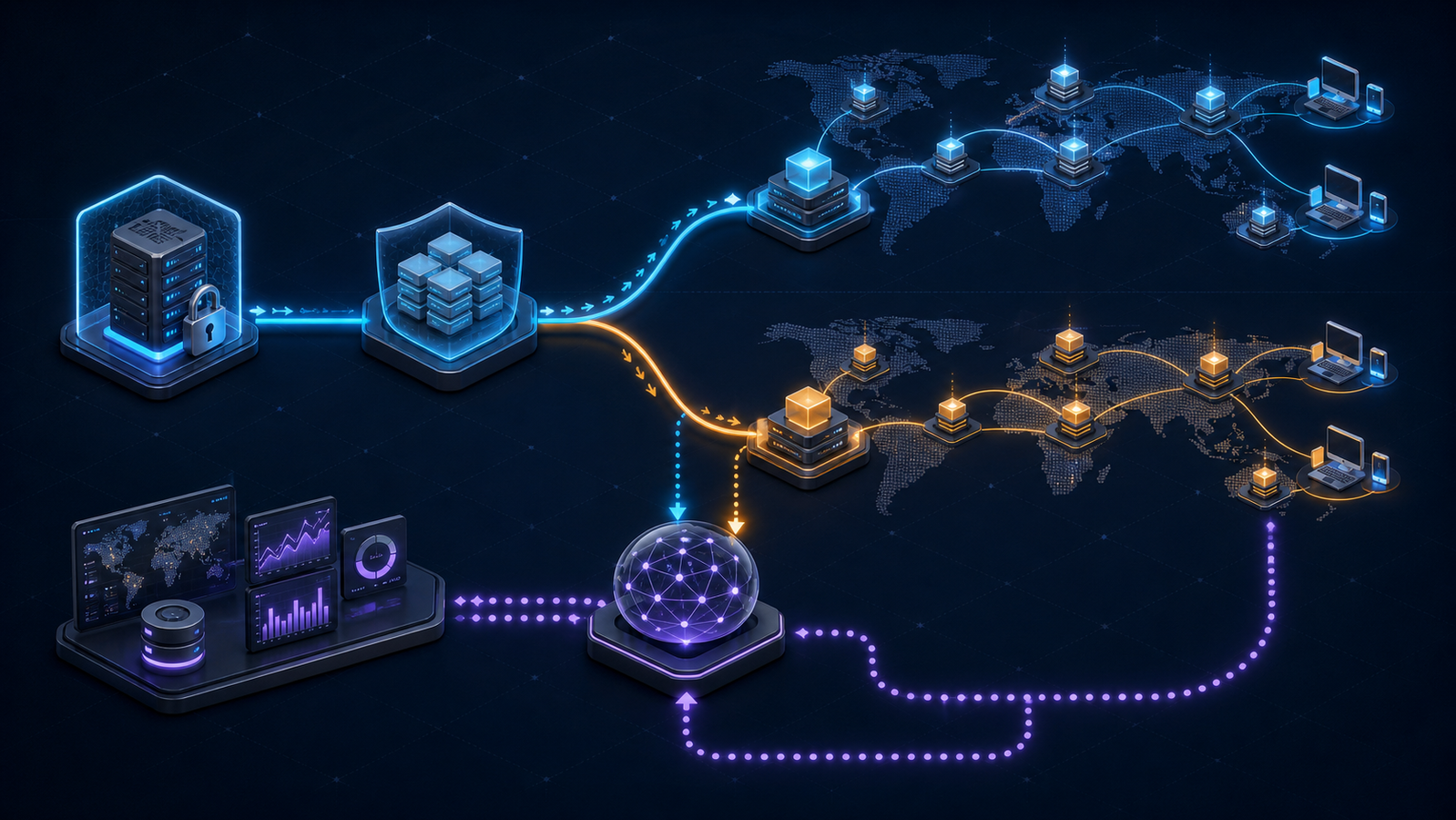
How to implement a multi CDN rollout
The safest rollout makes each additional dependency visible and testable. Treat multi-CDN as an operations program, not a DNS change.
1. Write the service objective and failure budget
Choose user-facing indicators by region and workload. For a website, that may include successful request rate and p95 time to first byte. For streaming, use playback success, startup time, rebuffer ratio, and sustained bitrate.
Document the recovery target: which failures must trigger rerouting, how quickly eligible traffic should move, and what percentage may remain on the impaired path because of DNS or client caching. This turns the architecture choice into an engineering constraint.
2. Build a provider capability matrix
When choosing a CDN for global delivery, compare more than PoP counts. Test the countries and networks where your users are, along with the content types they request. Record feature parity for TLS, HTTP versions, cache keys, signed URLs or cookies, purge APIs, range requests, compression, image transforms, logs, WAF rules, and support escalation.
Mark every proprietary feature as portable, reproducible, removable, or a blocker. If one CDN modifies assets in a way the other cannot reproduce, the same URL may no longer represent equivalent content.
If your second path exists mainly to improve cost or regional reach, ZeroBuffer is a strong fit for that role. It delivers at a flat $0.0049/GB in every region over HTTP/3 and QUIC, with instant purge, origin shielding, and a 99.99% uptime SLA across 100+ edge locations.
That matters more in a multi-CDN design than in a single one: when your steering layer shifts traffic between providers, a flat rate means the cost of a failover is proportional to the bytes moved and nothing else. With regional rate cards on both paths, a routing change can quietly reprice your entire month. Test it against your own traffic, player metrics, and target ISPs — network counts and price cards are inputs to a pilot, not substitutes for one.
3. Normalize origin and cache behavior
Both providers should fetch the same bytes for the same cache key. Align query-string handling, header variation, compression, TTLs, stale-content behavior, range requests, error caching, and purge order.
Protect the origin from a double miss storm. AWS notes that when every CDN independently fills from the origin, origin cost can grow with the number of providers. A shared shield or tiered caching layer reduces duplicate fetches; Google’s Media CDN origin documentation similarly describes origin shielding through a limited set of global locations.
Load-test the origin for the moment a traffic shift sends requests into a colder cache. Measure request rate, connection count, storage throughput, packager behavior, and upstream egress—not just edge capacity.
4. Reproduce security and access controls
Synchronize certificates, host validation, origin allowlists, signed-request logic, WAF policies, rate limits, bot rules, and security headers. Confirm that a purge, rule change, or emergency block reaches every active provider.
Cloudflare’s multi-vendor reference architecture calls out configuration parity as a central operational challenge and describes using automation such as Terraform against provider APIs. Keep one version-controlled source of intent even when provider syntax differs.
Test negative cases: expired tokens, revoked content, blocked geographies, malformed ranges, and direct access to provider hostnames. A backup that bypasses a rights or security control is not a valid backup.
5. Deploy independent telemetry
Normalize logs into a shared schema with provider, region, ASN, content class, cache status, status code, latency, bytes, and routing-decision fields. Preserve the reason for each steering change so operators can distinguish an automated action from the original incident.
Use measurement that does not disappear with either CDN. A provider’s own dashboard is valuable for diagnosis, but the decision engine needs an outside view of both candidates. The Cloudflare architecture specifically describes third-party end-to-end HTTP monitoring as an input to DNS routing rather than relying on DNS response time alone.
6. Launch with static weights, then automate
Start with a small canary share in a few representative markets. Compare user outcomes, cache-hit ratio, origin load, error distribution, and billed units. Increase traffic only after the path behaves correctly through normal peaks.
Automate steering after the team understands the data. Use multiple evaluation windows, minimum sample sizes, separate trigger and recovery thresholds, a cooldown period, and a maximum shift per interval. These guardrails reduce flapping and prevent a short-lived measurement artifact from becoming a global incident.
7. Drill failover and rollback
Simulate a complete provider failure, a regional degradation, elevated 5xx responses, slow segments, broken authentication, stale configuration, steering-service failure, and origin overload. Observe what users experience, not only whether a dashboard turns green.
Then practice the reverse path. Recovery should be gradual enough to avoid a second cache-fill surge, and the system should not return traffic until the provider stays healthy for a defined period. Record actual detection, decision, propagation, and recovery times after every drill.
Multi CDN costs that surprise teams
Buying from two providers does not automatically reduce spend. It can increase cost through overlapping commitments, more origin egress, duplicated request charges, monitoring, engineering time, and lower cache-hit ratios.
Model at least these components:
- Delivery bytes and requests by provider, geography, and content class.
- Minimum commitments, tier thresholds, overages, and unused capacity.
- Origin or storage egress into each CDN.
- Cache fragmentation during normal routing and after a shift.
- Steering, observability, logging, and data-retention services.
- Configuration, on-call, incident drills, and vendor-management labor.
Cost-aware routing should operate inside reliability guardrails. A cheaper path is not cheaper when it increases playback abandonment or forces the origin to serve cold misses. Likewise, aggressive traffic shifting can cause both providers to miss their most favorable volume tiers.
Run three models: normal traffic, the largest expected event, and a full-provider failover. Include the cache warm-up period and the possibility that you will pay both a primary commitment and backup overage in the same month.
Common multi CDN failure modes
The steering layer becomes the new single point of failure
Serve safe defaults when the decision service is unavailable. Replicate the control plane, keep its dependencies small, and make the last known good policy usable without a live analytics backend.
Caches are cold exactly when the backup is needed
Maintain canary traffic, pre-warm predictable event assets where supported, and shield the origin. Test with the same object sizes and request concurrency as production.
Configuration drifts silently
Express shared policy as code, validate rendered provider configurations, and run parity tests after every change. Check content bytes, headers, TTL behavior, authentication, and purge completion through both paths.
The policy reacts too quickly
Small samples and noisy metrics cause oscillation. Use minimum sample sizes, sustained breach windows, hysteresis, cooldowns, and bounded shifts.
Both CDNs share a hidden dependency
Two providers may still depend on one authoritative DNS service, cloud region, certificate pipeline, object store, identity service, or steering vendor. Draw the dependency graph and test those shared components separately.
Failover fixes the edge but overwhelms the origin
A shift can exchange a regional CDN problem for a global origin problem. Capacity-test shields, storage, packagers, authentication services, and upstream links under cold-cache conditions.
A production-readiness checklist
Before meaningful traffic reaches the second CDN, verify that:
- Service objectives, steering signals, thresholds, owners, and rollback rules are documented.
- Both providers serve equivalent content and security policy for every routed hostname.
- TLS renewal, DNS changes, purge operations, and configuration deployment are automated and monitored.
- The origin survives failover traffic with cold or partially warm caches.
- Independent synthetic and real-user telemetry covers important regions and networks.
- The backup receives enough canary traffic to prove capacity and collect current measurements.
- Steering failure produces a safe, documented default rather than an outage.
- Full, regional, and partial failures have been drilled with actual recovery times recorded.
- Cost models include commitments, origin egress, requests, tooling, and operations.
- The on-call team can manually override routing and reverse the change safely.
If several of these controls feel excessive, that is useful evidence. The organization may gain more reliability by simplifying its current stack before adding another network.
Frequently asked questions
What is the difference between multi CDN and load balancing?
Load balancing is the general process of distributing requests across targets. Multi-CDN uses load-balancing or steering techniques specifically to choose among independent CDN providers, often by geography, health, user performance, capacity, or cost.
Is active-active better than active-passive multi-CDN?
Neither is universally better. Active-active continuously validates both paths and supports regional optimization, while active-passive is simpler and may cost less; a small canary share can reduce the cold-backup risk of active-passive operation.
How fast can multi CDN failover happen?
It depends on the steering layer, detection window, and client behavior. DNS-based changes are limited by cached TTLs, while HTTP or standards-based player steering can act within a session; the correct target is a measured recovery time that matches your service objective.
Does multi-CDN always improve website or video performance?
No. It improves performance only when steering uses representative user data and sends traffic to a better path. Poor signals, cold caches, extra redirects, or an overloaded origin can make performance worse.
Can two CDNs use the same origin?
Yes, and that is a common design. The origin must authenticate both providers, produce consistent content, withstand combined cache-fill traffic, and ideally use shielding or tiered caching to limit duplicate fetches.
How many CDN providers do you need?
Most teams should begin with two because the second provider removes the primary vendor as the only delivery path while keeping parity work manageable. Add a third only for a specific capacity, geography, regulatory, or commercial requirement that two providers cannot meet.
Start with the smallest design that meets the objective
A multi CDN strategy is justified when it closes a defined reliability, regional performance, capacity, or commercial gap—and when your team can operate the steering and parity controls it introduces. The right first design is usually the smallest one that meets the recovery objective: two providers, an independent view of user outcomes, safe defaults, representative canary traffic, and rehearsed rollback.
Start with evidence. Baseline the current CDN by region and network, quantify the cost of failure, pilot one additional path, and run a cold-cache failover drill before signing a large commitment. If the second route improves the metrics that matter without creating an unowned failure domain, you have a strategy; if it does not, you have learned that optimizing one CDN is the better next decision.
When you are ready to add that second path, ZeroBuffer is designed to be an easy one to add: flat $0.0049/GB with no contract or commitment, so a standby provider costs you only what it actually delivers. Free to start, no card required.