
Choosing Akamai CDN video delivery is easy to justify when a failed premiere would cost more than the contract. The harder question is whether its scale and media tooling are worth a quote-based buying process for your particular audience.
This comparison separates what Akamai publicly documents from what must be tested or negotiated. You will see how its video path works, which speed metrics matter, why Akamai CDN pricing arrives as a quote rather than a rate card, how to normalize that quote, and when a simpler video streaming CDN may deliver a better cost-to-control ratio.
Is Akamai CDN good for video streaming?
Yes—Akamai is a credible enterprise choice for large live and on-demand video workloads. Its Adaptive Media Delivery service supports adaptive-bitrate streaming, HLS, MPEG-DASH and CMAF, with edge caching, origin failover options, traffic controls and a documented 100% availability SLA; the trade-off is that pricing and the exact service bundle require a sales conversation rather than a public rate-card calculation.
That makes Akamai strongest when operational assurance, global reach, content protection and support carry more weight than self-service onboarding or immediate price transparency. It does not make Akamai automatically fastest or cheapest for every viewer population. Only an audience-weighted pilot can answer that.
How Akamai CDN video delivery works
Akamai's video delivery product is called Adaptive Media Delivery, or AMD. The basic request path is familiar to any streaming engineer:
- Your encoder and packager create a manifest plus media segments at the origin.
- The player requests an HLS playlist or MPEG-DASH manifest through the CDN hostname.
- Akamai maps the viewer to an edge server, applies access rules, and serves cached objects where possible.
- A cache miss travels through the delivery hierarchy to your origin; later viewers can receive the same segment from the edge.
The current Adaptive Media Delivery overview says the service supports live and on-demand adaptive-bitrate delivery, third-party origins, HLS, MPEG-DASH and CMAF. Akamai also documents optional origin failover, token authentication, geo controls, watermarking support, access revocation and EdgeWorkers integration.
The Akamai product brief adds the video-specific mechanics that matter under load: advanced cache control, tiered distribution, segment prefetch, Quick Retry, HTTP/2 and HTTP/3 support, IPv6, TLS 1.3, log delivery and reporting.
There is an important scoping detail here. CDN delivery is not the same purchase as a complete video platform. Akamai's documentation lists Adaptive Media Delivery, Media Services Live, NetStorage, Image & Video Manager, DataStream and other services separately on its content-delivery product map. Ask which origin, storage, transcoding, packaging, player analytics, security and support components are included in the quote.
Akamai CDN video speed: measure playback, not ping time
The Akamai edge network and its media-specific caching give it the ingredients for strong performance, especially when many viewers request the same live segments. But a network-size claim or a generic CDN latency chart cannot predict playback quality for your audience.
Video speed is a chain. DNS mapping affects which edge a viewer reaches. TLS and connection setup influence the first request. Cache policy determines whether a segment comes from a nearby edge or travels to origin. Segment throughput and the player's adaptive-bitrate logic then determine startup, quality and stalls.
Measure these outcomes during a pilot:
| Metric | What it reveals | How to compare |
|---|---|---|
| Video startup time | Delay from play request to first rendered frame | P50, P95 and P99 by country, ISP and device |
| Rebuffer ratio | Share of playback time spent stalled | Use one definition across both vendors |
| Playback failure rate | Sessions that never start or terminate on error | Break down edge, origin, manifest, DRM and player errors |
| Average delivered bitrate | Quality the viewer actually receives | Compare within equivalent device and network cohorts |
| Segment throughput and TTFB | Whether the CDN feeds the ABR buffer fast enough | Test hot-cache and cold-cache requests separately |
| Cache offload | Traffic kept away from the origin | Compare bytes as well as request counts |
| Availability | Successful responses over total delivery attempts | Inspect regional tails, not only a global average |
Akamai's video measurement guidance treats startup time, rebuffering and bitrate as core quality-of-experience metrics. Its more detailed guidance also distinguishes synthetic testing from real-user monitoring: synthetic probes make controlled comparisons possible, while player telemetry shows what real devices and access networks experience.
This is why “Which CDN is faster?” has no honest universal answer. A provider may win cached VOD delivery in Mumbai and lose cold-cache startup in São Paulo. Weight each result by your actual traffic distribution, then compare the slowest cohorts that affect renewals and ad completion—not just the global median.
What the Akamai edge does well for performance
The documented strengths are a media-aware delivery path, ABR support, segment prefetch, retry behavior, tiered caching and optional origin failover. Akamai also exposes delivery reports and integrations for deeper observability, although the precise data products in your bundle need confirmation.
What still requires a proof of concept
Do not accept “nearest edge” as evidence of a better stream. Test cache-key behavior with signed URLs, manifest freshness for live channels, regional origin paths, HTTP/3 fallback, error recovery, and the load your packager sees during a cold start. Use your DRM, tokens, subtitles, ad markers and real player—not a clean demo asset.
Akamai CDN pricing for video: what you can verify
Akamai pricing for video delivery is quote-based, not published. Akamai does not display a public Adaptive Media Delivery rate card on the product page; its current call to action is to discuss requirements and pricing with sales, alongside a 30-day trial. That means third-party “Akamai price per GB” tables are estimates, anecdotes or negotiated-contract snapshots—not a price you can rely on.
The correct comparison starts with your quote and invoice definitions. Normalize every proposal into the same monthly model:
monthly delivery cost
= committed spend
+ delivery above the commit
+ region or traffic-class adjustments
+ request and log-delivery charges
+ support and managed-service fees
+ security, storage, encoding, packaging and origin costs
- contracted credits
Ask Akamai to price the same workload at your median month, peak month and event-spike month. A low committed per-GB rate can still lose if unused capacity is not carried forward, overage is expensive, premium regions are separate, or the features required for production sit outside the base delivery SKU.
The quote questions that change total Akamai pricing
- Is the commit monthly, annual or pooled across properties?
- Are overages billed at the contracted rate or a different rate?
- Do rates vary by geography, protocol, traffic class or delivery product?
- Which request, purge, log, certificate and support charges apply?
- Are origin failover, traffic management and real-time logs included?
- Does a trial reproduce the proposed production configuration?
- What happens to pricing when traffic is below the commit?
- What are the renewal uplift, termination and migration-assistance terms?
Also separate delivery economics from media-pipeline economics. Akamai's own live transcoding cost example models compute, pooled transfer and object storage as distinct parts of a workflow. Your RFP should likewise show CDN delivery, origin egress, storage, encoding and operations as separate lines before you compare totals.
A public-price baseline for context
A published pay-as-you-go rate gives finance a baseline while the Akamai quote is pending — and often ends the quote process. ZeroBuffer charges a flat $0.0049 per GB for global delivery, the same rate in every region, with no card required to start. At that rate, delivery alone works out as follows:
| Monthly delivery | Public-rate calculation | Delivery cost |
|---|---|---|
| 100 TB | 100,000 GB × $0.0049 | $490 |
| 500 TB | 500,000 GB × $0.0049 | $2,450 |
| 1 PB | 1,000,000 GB × $0.0049 | $4,900 |
These are not Akamai savings claims because there is no public Akamai price to subtract. They are a transparent comparison baseline. Apply any published volume discounts, storage, requests, encoding, support and taxes separately, then put the resulting number beside the complete Akamai quote.
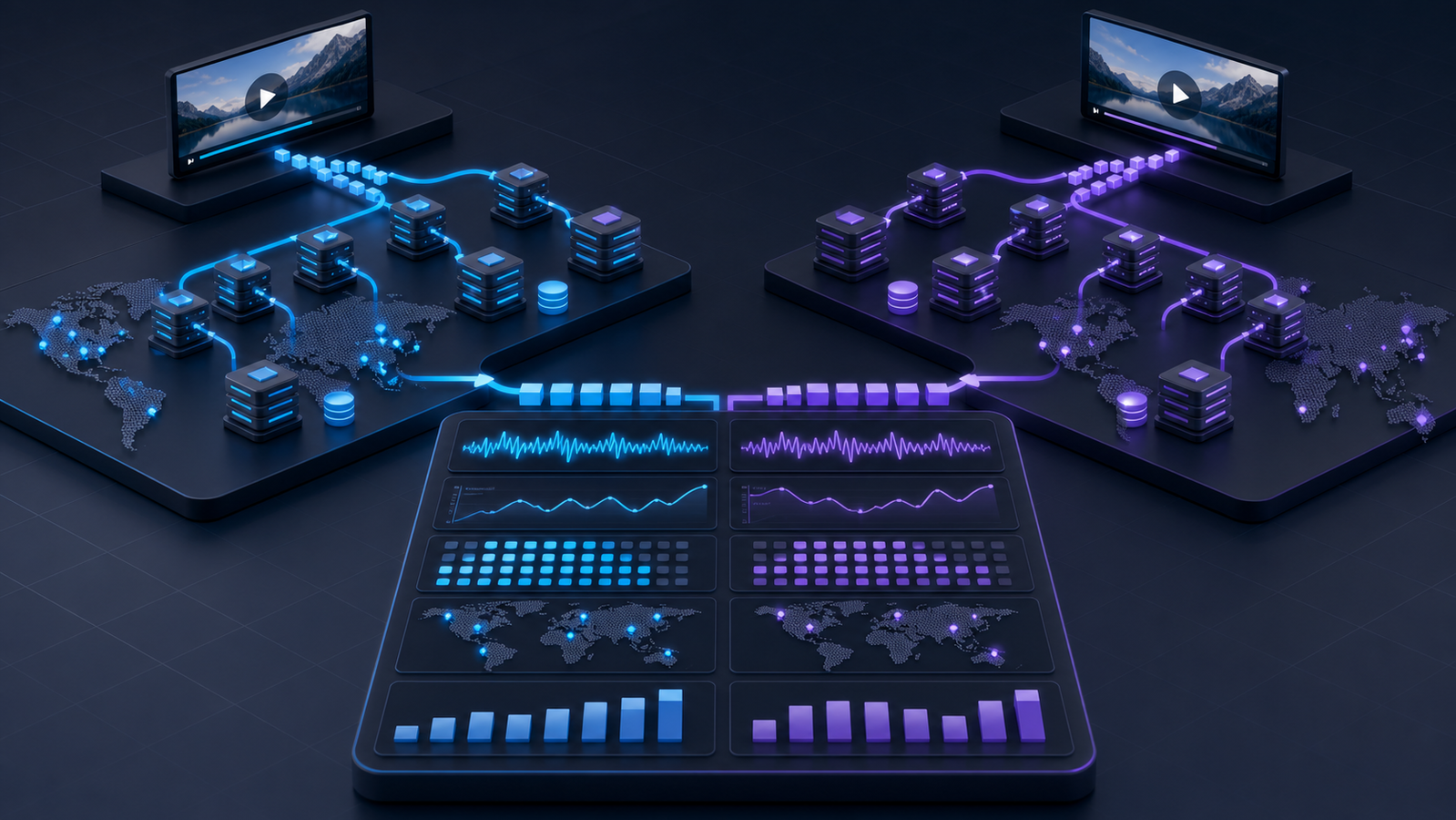
How to compare Akamai CDN video with alternatives
Run a controlled bake-off instead of choosing from feature grids. The goal is to expose the conditions that hurt real playback before they appear during a premiere. If you need the architecture and cost groundwork first, use this broader CDN for video guide.
1. Freeze a representative test workload
Choose at least one VOD title, one live or live-like stream, the production ABR ladder, real manifests, authentication, subtitles and DRM. Include popular segments that should cache well and long-tail assets that force misses. Record the expected regional and ISP mix.
2. Use identical traffic and telemetry
Send the same asset set through each CDN and split traffic with DNS or a multi-CDN steering layer. Keep player version, bitrate logic, origin and test window constant. Tag sessions with the serving CDN so player analytics can compare like with like.
3. Test steady state and failure state
Warm-cache benchmarks measure only the easy case. Add cold starts, traffic ramps, an unhealthy origin, an expired token, a purge, a changed manifest and packet loss. Confirm that retries do not create an origin storm or trap the player on stale content.
4. Score the regions you monetize
Create a weighted scorecard. Playback quality and availability should dominate, followed by origin protection, operational visibility, security requirements, support and normalized cost. Weight South Asia, the Middle East or Latin America according to real viewers rather than treating every country equally.
5. Keep claims and contract language separate
For each material feature, label it “documented,” “observed in pilot,” or “contracted.” A product page can document support for a protocol. Only the pilot can prove the result for your workload, and only the contract can define the remedy if service misses the agreed target.
Akamai versus a simpler streaming media CDN
The decision is less about “enterprise” versus “budget” and more about which complexity you need.
| Decision factor | Akamai Adaptive Media Delivery | Simpler pay-as-you-go video CDN |
|---|---|---|
| Buying motion | Sales-led, scoped quote | Self-service or short sales cycle |
| Public delivery price | Not listed on AMD page | Often published |
| Media delivery | Deep, mature feature set | Varies; verify HLS/DASH caching and failover |
| Content protection | Broad documented options | May require external DRM or security services |
| Operations | Rich controls and optional services | Smaller surface area, potentially easier to run |
| Best fit | Large, risk-sensitive streaming programs | Cost-sensitive teams with standard HTTP streaming workflows |
For teams that already operate standard HLS or DASH and mainly need predictable delivery, ZeroBuffer removes most of the reason to run the Akamai procurement cycle at all. It pairs the flat rate with S3-compatible NVMe storage at $0.01/GB per month per replica, multi-rendition encoding to 4K, 1080p, 720p, and 480p at no extra charge, per-second engagement and retention analytics, and a 99.99% uptime SLA across 100+ edge locations. Validate all of it against the same player telemetry and failure tests you would run for Akamai — the difference is that you can start the test today without a sales call.
Akamai is more likely to earn its complexity when you need its particular content-protection controls, global support motion, delivery reporting, edge logic or established live-event process. A simpler provider is more likely to win when your workflow stays portable, your team wants fast onboarding, and bandwidth economics dominate the business case.
A low-risk migration plan
Do not turn a price comparison into a big-bang cutover. Preserve the current CDN while you reproduce behavior on the candidate:
- Inventory hostnames, origins, cache keys, TTLs, headers, tokens, certificates, purges, log feeds and edge code.
- Configure the candidate against a staging origin or a controlled production path.
- Validate manifests, byte-range requests, captions, DRM, ads and every device family.
- Warm representative VOD objects and run load tests without viewer traffic.
- Shift a small, measurable cohort and compare playback plus origin metrics.
- Increase traffic only when regional guardrails pass; keep DNS and steering rollback ready.
- Retain the previous configuration until the observation window covers normal traffic and at least one realistic peak.
Akamai's product brief documents third-party origin support and open APIs, which can help keep a standards-based delivery path portable. Edge-specific request logic, authentication and reporting integrations usually require the most careful translation.
Frequently asked questions
How much does Akamai CDN cost for video?
Akamai does not publish a standard Adaptive Media Delivery rate card on its current product page. Request a quote based on monthly volume, peak traffic, audience geography, required security and support, then normalize committed spend, overage, add-ons and origin costs before comparing it with public-price alternatives.
Is Akamai pricing public?
No. Akamai pricing for Adaptive Media Delivery is not published as a rate card; the product page directs buyers to a sales conversation and a 30-day trial. Treat any per-GB figure you find in a third-party comparison as an unverified estimate, and normalize your own quote against a published pay-as-you-go rate before judging it.
Is the Akamai edge the same thing as Akamai CDN?
Not exactly. “Akamai edge” describes the distributed server footprint that terminates viewer connections and serves cached media, while the CDN product you buy for video is Adaptive Media Delivery. Akamai also brands separate edge services—edge compute, edge DNS and security products among them—so confirm which of them your quote actually includes.
Does Akamai support HLS and MPEG-DASH?
Yes. Akamai's Adaptive Media Delivery documentation lists support for HLS, MPEG-DASH and CMAF for adaptive-bitrate live and on-demand streaming.
Is Akamai a CDN or a complete video platform?
Akamai provides CDN delivery plus separate cloud, storage, live-media, image/video management, analytics and security services. Confirm which products are included because buying Adaptive Media Delivery alone does not automatically mean every encoding, storage, packaging, player or analytics function is bundled.
What is the best alternative to Akamai for video streaming?
The best alternative is the provider that matches Akamai on your audience-weighted playback guardrails while improving the constraint you care about—usually price transparency, onboarding speed or operational simplicity. Test the same HLS or DASH workload across both providers and compare startup time, rebuffering, failures, cache offload, support and complete monthly cost.
Can I use multiple CDNs for video?
Yes. A multi-CDN design can steer traffic by region, performance or availability, but it also adds configuration parity, log normalization and decision-engine work. Use it when the resilience or regional performance gain justifies operating two delivery paths.
Conclusion: choose with a workload, not a logo
Akamai CDN video delivery belongs on the shortlist for high-scale, risk-sensitive streaming. Its documented media features, availability commitment and operational options are substantial; its fit depends on a private quote and on performance measured with your viewers, player and origin.
Before signing, run the same production-like workload through two providers, score the regional tail, and normalize every cost line. Choose Akamai when the tested assurance and service depth justify the contract.
Choose a simpler delivery stack when it meets the same playback guardrails with clearer economics and less operational weight. ZeroBuffer publishes its full rate card — flat $0.0049/GB worldwide, encoding included, free to start with no card — so you can price that comparison before the Akamai quote even arrives.