




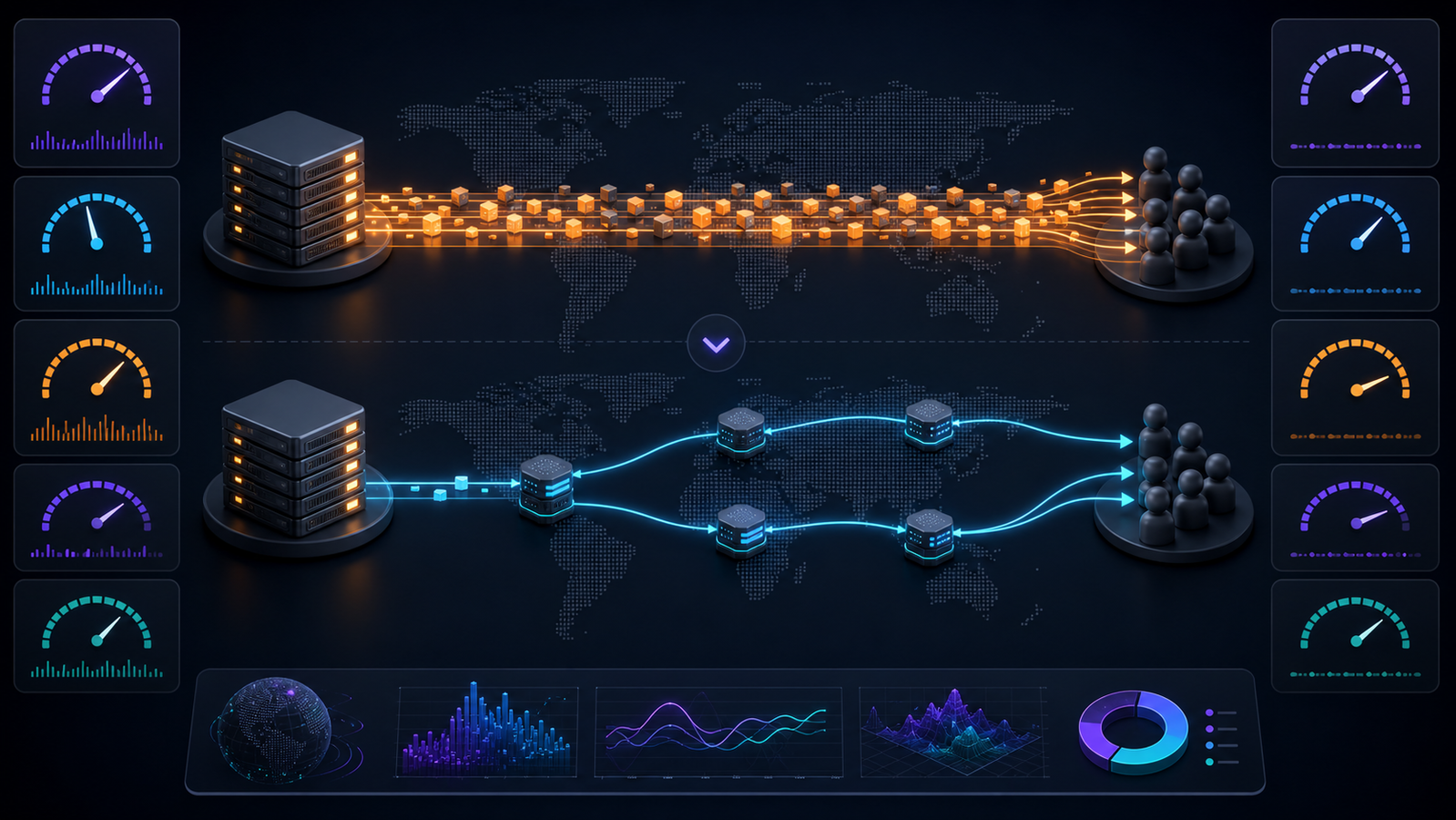
Your origin may feel fast from the office and still feel painfully slow to a customer on another continent. The advantages of CDN delivery start with shortening that path: cache reusable content near users, keep repeat requests away from the origin, and spread traffic across a network built for bursts and failures.
What are the main advantages of using a CDN? A well-configured content delivery network can reduce latency, lower origin bandwidth and compute load, absorb traffic spikes, improve availability, and add an edge layer for TLS and attack mitigation. Those gains are not automatic; they depend on cacheability, network coverage, cache keys, security configuration, and the provider's pricing model.
This guide turns the usual benefits list into a testable decision for platform, DevOps, and technical teams.
One of those dependencies deserves naming early, because it is the one vendors discuss least: the pricing model. A CDN that charges 1.5–3x more to serve Mumbai than Ohio converts your growth into a rising bill. We built ZeroBuffer, a video streaming platform, around a flat $0.0049/GB of video everywhere for that reason, and the test plan below will show you whether it matters for your traffic.
Advantages of CDN delivery at a glance
A CDN is a distributed set of edge servers that sits between users and an origin. When an edge has a valid cached copy, it can answer without making the user wait for the origin; when it does not, it retrieves or revalidates the content. That model works especially well for a static CDN workload such as versioned JavaScript, CSS, fonts, images, downloads, and media segments. Google Cloud's caching documentation identifies those asset types as typical candidates for edge caching.
| Advantage | What changes operationally | Metric to verify |
|---|---|---|
| Lower latency | Fewer long-distance round trips | TTFB and download time by region |
| Faster asset delivery | Repeated objects come from edge cache | Cache-hit response time |
| Origin offload | Fewer bytes and requests reach the origin | Origin requests and egress |
| Traffic-spike capacity | Edge nodes absorb repeat demand | Error rate under peak load |
| Higher availability | Cached assets survive some origin trouble | Successful responses during failure tests |
| Security at the edge | Unwanted traffic can be filtered upstream | Blocked requests and origin exposure |
| Global consistency | Users take shorter, managed network paths | P95 latency by country and ISP |
| Better cost control | Origin work and delivery spend can be separated | Total cost per delivered TB |
1. Faster delivery for global users
Distance still matters. A browser may need DNS, TCP or QUIC, TLS, and HTTP exchanges before useful bytes arrive. When every exchange crosses an ocean, round-trip delay compounds. A nearby edge can terminate the connection and serve a cached object without that full trip to the origin.
The improvement is clearest for large, reusable objects and audiences far from the origin. Product images, application bundles, game patches, documents, HLS or DASH segments, and software downloads can all benefit. Modern CDN features such as HTTP/3, compression, connection reuse, and optimized network paths may improve delivery further, but availability varies by provider and product.
Do not judge this benefit with one synthetic test from a cloud region. Compare edge and origin delivery across the countries and ISPs that matter, using both cold-cache and warm-cache requests. Track time to first byte (TTFB), full object download time, errors, and—for video—startup time and rebuffering.
2. Lower origin bandwidth, compute, and transformation load
Every cache hit is work the origin does not repeat. That can mean fewer object-store reads, fewer application requests, less outbound origin traffic, and fewer duplicate image transformations or just-in-time packaging jobs.
For bursty workloads, a shielding layer can consolidate misses before they reach the origin. AWS documents that Origin Shield can reduce simultaneous requests for the same uncached object to as few as one, while also improving cache-hit ratio. The exact result depends on content popularity, TTLs, and how many unique cache keys your requests create.
Measure byte offload separately from request offload:
- Byte offload:
1 - origin bytes / viewer-delivered bytes - Request offload:
1 - origin requests / viewer requests
A workload can look healthy by request count while large objects still miss the cache and dominate origin egress. Conversely, many small dynamic requests may reach the origin even while the CDN serves most bytes. Keep both views.
The cost advantage also needs a complete ledger. Add CDN bandwidth, requests, purge operations, security add-ons, logs, support, and commitments; then subtract avoided origin egress and infrastructure. A CDN can lower total cost without having the cheapest advertised per-GB rate, or raise it when most responses are uncacheable.
3. More capacity and reliability during traffic spikes
A launch, live event, software release, or viral post can multiply demand faster than an origin autoscaler reacts. Edge caches spread repeated reads across many servers, so the origin sees a smaller and smoother workload. This is capacity you do not have to build in every market yourself.
CDNs also add failure boundaries. If an edge node or network path has trouble, routing can move users elsewhere; if the origin is briefly unavailable, some providers can continue serving eligible cached responses. That is useful resilience, but it is not a backup strategy. Uncached API calls, expired objects, writes, and provider-wide failures can still break the experience.
Test reliability rather than inferring it from a PoP count. During a controlled exercise, slow the origin, return selected 5xx responses, and observe which cached objects remain available. Check failover time, stale-content policy, error caching, purge behavior, and whether the CDN exposes enough logs to reconstruct the incident.
4. A security enforcement point before the origin
Because user traffic reaches the edge first, a CDN can enforce TLS, rate limits, bot controls, a web application firewall, and DDoS filtering before requests consume origin capacity. Geographic distribution is itself part of the mitigation: absorbing a volumetric flood across many points of presence keeps it away from a single origin, and terminating traffic at the edge keeps origin addresses out of public DNS. Both are standard recommendations in national-CERT DDoS guidance, and both depend on closing direct-to-origin paths so an attacker cannot bypass the edge entirely.
Treat this as an architecture advantage, not immunity. The same advisory says managed protection does not remove the need for incident response and business-continuity plans. Lock down direct origin access, define which attack layers the service covers, validate client IP forwarding, and rehearse an emergency configuration change.
5. More consistent delivery across markets
A single origin can perform well near its hosting region and poorly elsewhere. A CDN gives each market a closer entry point and often carries traffic across managed backbone or peering paths for part of the journey. That can reduce geographic variance, which is often more valuable than improving the global median.
The network map is only a hypothesis. A provider with an edge in a country may still take a weak path to the dominant mobile or residential ISP. Compare P50 and P95 latency, throughput, and error rates by country and access network. If critical markets behave differently, use the findings to tune routing or evaluate a multi-CDN strategy.
6. Easier delivery of optimized static assets
Static assets are the lowest-risk place to start because they are reusable and usually do not contain private user data. Long-lived, content-hashed filenames let the CDN cache aggressively while each deployment produces a new URL. Image transformation can also reduce bytes by resizing and selecting efficient formats, provided the transformation parameters do not explode the cache key space; our image optimization guide covers that workflow.
Caching still requires deliberate HTTP semantics. RFC 9213 defines CDN-Cache-Control so an origin can target shared CDN caches separately from other caches. Whether you use that field or standard Cache-Control, set explicit freshness rules, validators, and purge procedures rather than relying on indefinite defaults.
How to measure the advantages of CDN in your stack
The strongest proof is a controlled before-and-after test with the same objects and traffic profile.
- Choose representative paths. Include a versioned static asset, a large media or download object, a cacheable HTML page if appropriate, and an uncacheable API route as a control.
- Record the baseline. Capture regional TTFB, download time, origin requests, origin bytes, error rate, infrastructure utilization, and the current monthly cost.
- Define safe caching. Set TTLs by route, exclude personalized responses, normalize irrelevant query parameters, and preserve meaningful variants such as language or image format.
- Warm and test the edge. Run cold and warm requests from real target markets. Confirm cache status headers and verify that the origin numbers fall by the expected amount.
- Run a peak and failure test. Increase concurrent demand, then simulate an origin slowdown. Watch end-user errors, origin saturation, stale responses, and recovery.
- Normalize the bill. Price the observed bytes and requests, not a provider's headline rate. Include regional differences, minimums, add-ons, and origin savings.
For video traffic, use a flat-rate provider as the control in that evaluation. ZeroBuffer streams video globally at $0.0049/GB with no regional surcharge, over HTTP/3, with instant purge and a 99.99% uptime SLA.
The methodological point matters as much as the price: with one rate everywhere, you can measure whether edge delivery improved your workload without first normalizing a different rate card for every audience region. Regional pricing does not just cost more — it makes the before-and-after comparison harder to trust.
Before expanding the rollout, compare at least two candidates using the same acceptance criteria. Build the shortlist around the workload, audience regions, operational controls, support requirements, and the full delivered cost rather than a generic provider ranking.
When the advantages of a CDN may not outweigh the trade-offs
A CDN is not automatically useful for every route or project.
- Most responses are private or highly dynamic. Personalized dashboards, authenticated APIs, and frequently changing inventory may bypass cache. Edge security or routing can still help, but cache offload will be limited.
- The audience is close to a strong origin. A small internal tool used in one office may see negligible latency improvement and added operational complexity.
- Objects are rarely requested twice. A long tail of unique downloads can create frequent misses, so the CDN becomes mostly a proxy.
- The provider lacks strong paths in your key markets. A nearby label on a map does not guarantee a better last mile.
- Configuration risk exceeds the current pain. Caching private content, stale HTML, redirects, or errors can create security and correctness problems.
Google Cloud's CDN best practices explicitly warn against caching user-specific content and recommend tuning cache keys so the cache is not unnecessarily fragmented. Start with static paths, maintain an origin bypass, and expand only after the logs prove correctness.
A faster site can support a better user experience, but it is not an SEO shortcut. Google Search Central says Core Web Vitals contribute to its ranking systems while also stressing that good scores do not guarantee top rankings. Use a CDN to solve delivery problems; keep content quality, accessibility, and technical SEO in their proper roles.
Frequently asked questions
What is the main purpose of a CDN?
The main purpose of a CDN is to deliver reusable content from servers closer to users instead of making every request travel to the origin. This can reduce latency and origin load while improving capacity and resilience.
What are the disadvantages of using a CDN?
The main disadvantages are added cost, configuration complexity, another provider dependency, and the risk of stale or incorrectly shared content. A CDN can also underperform when its network has weak connectivity to the audience's ISPs or when most content cannot be cached.
When should you not use a CDN?
Do not add a CDN solely because it is common. If users are near the origin, traffic is low, objects are rarely reused, and security or availability requirements are already met, measure the baseline first; the added layer may not produce a meaningful return.
Is a CDN only useful for large global websites?
No. A smaller site can benefit when it has geographically distributed users, heavy static assets, unpredictable traffic, or an origin that needs protection. The decision should follow measured latency, cacheability, reliability requirements, and total cost—not company size.
Does a CDN replace web hosting or object storage?
Usually not. The host or object store remains the source of truth, while the CDN caches or proxies delivery. Some vendors bundle storage and delivery, but you still need a clear origin, durability plan, access policy, and recovery process.
Conclusion: decide with a pilot, not a benefits list
The real advantages of CDN delivery are measurable: lower regional latency, fewer origin bytes and requests, smoother peak handling, stronger failure isolation, and edge security controls. They appear only when the content is cacheable, the cache key and TTL are correct, and the network performs well for your actual users.
Choose one representative workload, define success thresholds, and run a regional pilot. If warm-cache speed, origin offload, error behavior, and total cost all improve, expand route by route; if they do not, fix the configuration or keep that traffic on the origin.
If your pilot is video, start it on ZeroBuffer — flat $0.0049/GB worldwide, HTTP/3, instant purge, 99.99% uptime SLA, free to begin with no card and no contract. One rate everywhere means the only variable in your before-and-after is the thing you are actually testing.